Historical Werra Bridge


Below today's Werra Bridge in Hann. Münden was a natural rock bar. This so-called "Werrahohl" forced skippers in the Middle Ages to unload their cargo first so that they could then pass the obstacle with less draught. A wooden predecessor was followed in the 1220s by the new stone structure that has survived to this day.
The six arches of the bridge are supported by five piers with acute-angled icebreakers on the southeast side. The 105-metre-long bridge not only connected the old town with the historic suburb of Blume. Rather, it was an important bottleneck on the long-distance trade route coming from Frankfurt am Main, which led from the Hessian depression via Kassel and the Leine valley to Braunschweig and on to northern Germany.
The bridge was roofed over around 1400. There is documentary evidence of a bridge toll from this time, which was collected until the middle of the 19th century and provided the town with important income. The drawbridge, which can be seen in historical views, the small defence towers, iron portcullis and the customs house bear witness to Münden's important function as a trade and transport hub.
In the course of the extension of the Chaussee from Hanover to Kassel, the canopies were removed as early as 1777/79 so that larger carts could also pass the bridge. The structure was repeatedly damaged by floods, ice and other environmental influences and was last completely renovated in 1986.
The six arches of the bridge are supported by five piers with acute-angled icebreakers on the southeast side. The 105-metre-long bridge not only connected the old town with the historic suburb of Blume. Rather, it was an important bottleneck on the long-distance trade route coming from Frankfurt am Main, which led from the Hessian depression via Kassel and the Leine valley to Braunschweig and on to northern Germany.
The bridge was roofed over around 1400. There is documentary evidence of a bridge toll from this time, which was collected until the middle of the 19th century and provided the town with important income. The drawbridge, which can be seen in historical views, the small defence towers, iron portcullis and the customs house bear witness to Münden's important function as a trade and transport hub.
In the course of the extension of the Chaussee from Hanover to Kassel, the canopies were removed as early as 1777/79 so that larger carts could also pass the bridge. The structure was repeatedly damaged by floods, ice and other environmental influences and was last completely renovated in 1986.
Good to know
Openings
freely available
General information
Parking Available
Bus stop available
Eligibility
Target Group the Elderly
for Groups
for individual guests
Pet allowed
Suitable for Pushchair
Foreign Language
German, English
Other Furnishing/Equipment
Barrier-free access
Payment methods
Entrance Free
Accessibility
General Information on Accessibility
Cobblestone
Hygiene and infection safety measures
Distance control
Mouth-nose covering compulsory
Directions & Parking facilities
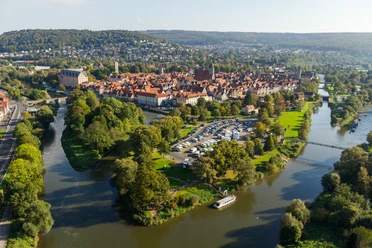
Accessible via the main pedestrian zone "Lange Straße" (on foot) or via the "Blume" car park (by car).
More information
From the Werra Bridge you can reach the Werra promenades "Dielengraben" and "Wanfrieder Schlagd", as well as the island "Doktorwerder".
Contact person
Hann. Münden Marketing GmbH
Lotzestraße 2
34346 Hann. Münden
Author
Hann. Münden Marketing GmbH
Lotzestraße 2
34346 Hann. Münden
Organization
Hann. Münden Marketing GmbH
Lotzestraße 2
34346 Hann. Münden
License (master data)
Hann. Münden Marketing GmbH

Nearby