Doctor Eisenbart's death house

Johann Andreas Eisenbart, better known as Doctor Eisenbart, is probably one of the most famous traveling doctors in the Baroque period. Born on March 27, 1663 in Oberviechtach as the son of the oculist (ophthalmologist), fracture and stone cutter (surgeon) Matthias Eisenbart, he learned for over ten years from his brother-in-law, Alexander Biller, in Bamberg and followed in his father's professional footsteps.
Eisenbart received the privilege of treating the local population from ten German principalities and traveled from market to market throughout the German-speaking area.
Shaken by the consequences of a stroke and suffering from foot gout, Eisenbart stopped in Hann in 1727 from his trip to Göttingen. Münden, where he died on November 11, 1727 in what was then the "Zum Wilden Mann" inn.
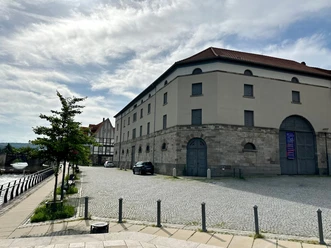
Traces of his work can still be seen in the city center, including a figure of Doctor Eisenbart above the entrance to the house where he died.
Eisenbart received the privilege of treating the local population from ten German principalities and traveled from market to market throughout the German-speaking area.
Shaken by the consequences of a stroke and suffering from foot gout, Eisenbart stopped in Hann in 1727 from his trip to Göttingen. Münden, where he died on November 11, 1727 in what was then the "Zum Wilden Mann" inn.
Traces of his work can still be seen in the city center, including a figure of Doctor Eisenbart above the entrance to the house where he died.
Good to know
Price info
free of charge
Directions & Parking facilities
On foot in the city center of Hann. Münden reachable.
Author
Deutsche Märchenstraße e.V.
Kurfürstenstraße 9
34117 Kassel
Organization
Deutsche Märchenstraße e.V.
Nearby