Main Cycle Tour 04 - Stage Marburg - Frankenberg


- 2:55 h
- 42.85 km
- 246 m
- 125 m
- 180 m
- 353 m
- 173 m
- Start: Marburg, city center
- Destination: Frankenberg, market square
Initially flat for a long time, well developed and suitable for families. Hilly at the end of the Wetschaft Valley. Well signposted.
Difficulty level: rather demanding
Trail quality: ★★★☆
Signposting: ★★★☆
North of Marburg, the well-developed Lahn cycle path takes you via Cölbe to the municipality of Lahntal. The painter Otto Ubbelohde, who created hundreds of illustrations for the Brothers Grimm's "Children's and Household Tales", lived here in the district of Gößfelden. He often drew inspiration for his drawings from the surrounding area. An approx. 1.5-kilometre circular trail runs through Gößfelden, linking Ubbelohde's places of inspiration and drawing. 16 information boards along the way explain the artist's life and work.
The pastor and teacher Johann Heinrich Christian Bang, who had a close friendship with Professor Friedrich Carl von Savigny, also lived in Gößfelden. The latter established contact with the Brothers Grimm. The legends collected by Bang from the Marburg region were thus made accessible to the Grimm brothers.
According to legend, gnomes piled up huge boulders in the Brungershausen district in ancient times. They used them to mark the location of their treasures. You can explore the group of rocks via a detour and hiking trail. There are also redoubts from the Seven Years' War between Prussia and France in Bungershausen. If you want, you can cycle directly from the Wichtelhäuser Steinen to Wetter, although the route is hilly at the start. If you want to take it easier, cycle back along the Lahn Cycle Path and change to the Lahn-Eder Cycle Path in Gößfelden.
In Wetter, you will find a diverse ensemble of half-timbered buildings around the historic market square with the outstanding collegiate church from the 13th century. The Diebesturm tower served as the model for Ubbelohde's drawing for the fairy tale "The Old Hunter".
Parallel to the Burgwaldbahn, the rest of the trail follows the route of the Lahn-Eder cycle path, which leads through the beautiful Wetschaft valley. From Münchhausen, the Christenberg in the Burgwald forest is very close by. Here you have to climb approx. 150 meters in altitude over 4 kilometers. The reward at the top is a phenomenal view. Otto Ubbelohe chose this spot for his drawings of the fairy tales
"Cinderella" and "Hansel and Gretel".
Tranquil farming villages lie along the route below. The Huguenot and Waldensian villages of Todenhausen and Wiesenfeld are of particular cultural and historical interest. Garden lovers should take a look at the beautifully laid out herb garden at the church in Wiesenfeld.
The cycle route gradually climbs and reaches the watershed between the Lahn and Eder or the Rhine and Weser.
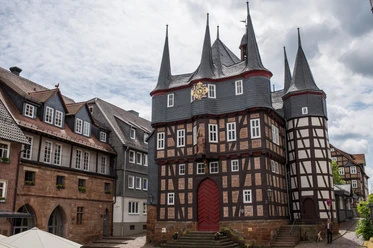
From here, the route descends into the Eder valley to the former district town of Frankenberg, a place well worth seeing with its historic old town, Gothic Church of Our Lady and the magnificent ten-towered town hall with its wonderful carillon. From the former castle at the witches' tower, you have a very good view of the town.
Once you've finished cycling, it's worth strolling through the half-timbered town and taking in the sights. A visit to the Thonet Museum is a must for furniture and design fans. The interestingly designed museum illustrates the history of the company through the furniture it produced. The museum focuses on the manufacturing processes developed by Thonet. The best-known piece of seating furniture is the "Viennese coffee house chair", which became a classic. Thonet moved the company to Frankenberg in 1889 because of the special beech wood in the nearby Kellerwald forest.
Frankenberg's historic town hall dating back to 1509 is particularly impressive. With its ten towers, the building, which is one of the most beautiful town halls in Germany, dominates the view between Obermarkt and Untermarkt. Philipp Soldan, a sculptor from the Middle Ages, left his mark on the town and in particular on the town hall with his piggyback figures. This is why Frankenberg can also call itself the Philipp Soldan town. On the way towards Burgberg, you pass the Liebfrauenkirche, one of the oldest Gothic churches in Germany. Attached to the side is an extraordinary chapel. From the Burgberg, where the fortress of the Franks once stood - which gave the town its name - you can enjoy a magnificent panoramic view of the town. Back at the town hall, we climb a stone spiral staircase up to the council chamber and wedding room. Hardly anything has changed here for 500 years. The centuries-old construction of the oak beams is still perfectly intact.
Difficulty level: rather demanding
Trail quality: ★★★☆
Signposting: ★★★☆
North of Marburg, the well-developed Lahn cycle path takes you via Cölbe to the municipality of Lahntal. The painter Otto Ubbelohde, who created hundreds of illustrations for the Brothers Grimm's "Children's and Household Tales", lived here in the district of Gößfelden. He often drew inspiration for his drawings from the surrounding area. An approx. 1.5-kilometre circular trail runs through Gößfelden, linking Ubbelohde's places of inspiration and drawing. 16 information boards along the way explain the artist's life and work.
The pastor and teacher Johann Heinrich Christian Bang, who had a close friendship with Professor Friedrich Carl von Savigny, also lived in Gößfelden. The latter established contact with the Brothers Grimm. The legends collected by Bang from the Marburg region were thus made accessible to the Grimm brothers.
According to legend, gnomes piled up huge boulders in the Brungershausen district in ancient times. They used them to mark the location of their treasures. You can explore the group of rocks via a detour and hiking trail. There are also redoubts from the Seven Years' War between Prussia and France in Bungershausen. If you want, you can cycle directly from the Wichtelhäuser Steinen to Wetter, although the route is hilly at the start. If you want to take it easier, cycle back along the Lahn Cycle Path and change to the Lahn-Eder Cycle Path in Gößfelden.
In Wetter, you will find a diverse ensemble of half-timbered buildings around the historic market square with the outstanding collegiate church from the 13th century. The Diebesturm tower served as the model for Ubbelohde's drawing for the fairy tale "The Old Hunter".
Parallel to the Burgwaldbahn, the rest of the trail follows the route of the Lahn-Eder cycle path, which leads through the beautiful Wetschaft valley. From Münchhausen, the Christenberg in the Burgwald forest is very close by. Here you have to climb approx. 150 meters in altitude over 4 kilometers. The reward at the top is a phenomenal view. Otto Ubbelohe chose this spot for his drawings of the fairy tales
"Cinderella" and "Hansel and Gretel".
Tranquil farming villages lie along the route below. The Huguenot and Waldensian villages of Todenhausen and Wiesenfeld are of particular cultural and historical interest. Garden lovers should take a look at the beautifully laid out herb garden at the church in Wiesenfeld.
The cycle route gradually climbs and reaches the watershed between the Lahn and Eder or the Rhine and Weser.
From here, the route descends into the Eder valley to the former district town of Frankenberg, a place well worth seeing with its historic old town, Gothic Church of Our Lady and the magnificent ten-towered town hall with its wonderful carillon. From the former castle at the witches' tower, you have a very good view of the town.
Once you've finished cycling, it's worth strolling through the half-timbered town and taking in the sights. A visit to the Thonet Museum is a must for furniture and design fans. The interestingly designed museum illustrates the history of the company through the furniture it produced. The museum focuses on the manufacturing processes developed by Thonet. The best-known piece of seating furniture is the "Viennese coffee house chair", which became a classic. Thonet moved the company to Frankenberg in 1889 because of the special beech wood in the nearby Kellerwald forest.
Frankenberg's historic town hall dating back to 1509 is particularly impressive. With its ten towers, the building, which is one of the most beautiful town halls in Germany, dominates the view between Obermarkt and Untermarkt. Philipp Soldan, a sculptor from the Middle Ages, left his mark on the town and in particular on the town hall with his piggyback figures. This is why Frankenberg can also call itself the Philipp Soldan town. On the way towards Burgberg, you pass the Liebfrauenkirche, one of the oldest Gothic churches in Germany. Attached to the side is an extraordinary chapel. From the Burgberg, where the fortress of the Franks once stood - which gave the town its name - you can enjoy a magnificent panoramic view of the town. Back at the town hall, we climb a stone spiral staircase up to the council chamber and wedding room. Hardly anything has changed here for 500 years. The centuries-old construction of the oak beams is still perfectly intact.
Waypoints
Start


Good to know
Best to visit
suitable
Depends on weather
Tour information
Cultural Interesting
Possibility of Accommodation
Stop at an Inn
Suitable for Bike
Contact person
Deutsche Märchenstraße e. V.
Ms. Jutta Arbter
Kurfürstenstraße 9
34117 Kassel
Author
Deutsche Märchenstraße e.V.
Kurfürstenstraße 9
34117 Kassel
Organization
Deutsche Märchenstraße e.V.
Kurfürstenstraße 9
34117 Kassel
Author´s Tip / Recommendation of the author
Ausgeruht in die Tagesetappe starten: das märchenhafte Hotel Marburger Hof
Our recommendations
Nearby